
Current State of Testing
The Neuron Specific Enolase Functional Activity Stroke Test (NSE-FAST) has been bench tested, animal tested (see publications) and tested in two human pilot studies. These are a study in patients presenting with stroke symptoms at the Guthrie Stroke Center in Pennsylvania and a test in Mixed Martial Arts (MMA) fighters.
Descriptions of the Guthrie Pilot Study and MMA brain injury pilot and the results obtained can be seen in below.
Guthrie Pilot Stroke Study
The TET NSE-FAST provides an objective measure of acute brain injury associated with strokes – the leading cause of disability in the US, but improperly diagnosed in the ambulance half of the time. Today, the gold standard for identifying a stroke is the NIH Stroke Score (NIHSS) based on patient symptoms only.
A pilot study in patients presenting with stroke symptoms was run at the Gutherie Stroke Center in northern Pennsylvania with results pending publication that demonstrated the utility of the NSE-FAST for detecting acute brain injury.
MMA Pilot
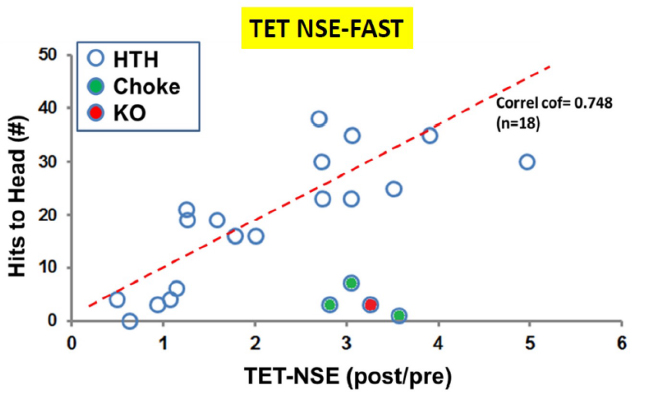
To evaluate applying TET to concussion, the TET assay was brought to a mixed martial arts tournament in Rochester, NY where fighters had blood drawn and measured for NSE activity before and after a 15 minute fight. Students in the audience counted the times each fighter was hit in the head. The plot below shows a number of important aspects of the NSE-FAST.
1. That active NSE can me measured within minutes of the neuronal injury as the 2nd test was run immediately after the 15 minute fight.
2. That the test is quantitative as the more hits to the head the more active NSE is released into the bloodstream
3. The amount of active NSE rises dramatically with levels as high as 5x (400% increase) over the pre-fight level.
4. That the NSE-FAST is able to detect neuronal injury from oxygen deprivation (Ischemia) as the green dots representing chokes to unconsiousness with few hits to the head, were equivalent to 20 to 30 hits.